
sys // photonic-insecticide v2.0
payload: 1550 nm · ~0.5–3.5 J/shot
targets neutralized: 000
Autonomous Photonic Pest Control
Insecticide,
at the speed of light.
Drones that hunt crop pests one by one with a 0.5-joule laser pulse. No chemicals, no resistance, no drift — priced at ~$10/ha, competitive with chemicals.
▲ live simulation — aim and click to neutralize a beetle yourself
0.0 J
energy per beetle
0k+
shots per battery
~$0/ha
value-based price
0 Hz
MEMS re-targeting rate
0.00 L
chemicals released
Listen // The deep dive
Two hosts unpack the machine
A relaxed, roughly hour-long conversation on how the autonomous laser drone finds, tracks and neutralises crop pests one at a time — the optics, the economics and the open questions. Put it on and listen.
Shooting crop pests with autonomous lasers
Podcast-style discussion · ~55 min
One correction pending. This discussion still contains an obvious error — we’re aware of it and will publish a corrected version soon.
Vision // Automation
The future of agriculture is automated
Autonomous agricultural drones — docking, charging and flying fields unattended
We believe the next step is light.
The infrastructure is ready. The next step is light.
Autonomous agricultural drones are not a concept — they are a shipped, commercial reality. Everything the hard part of this needs already exists off the shelf:
4,000
battery cycles
Proven commercial endurance on today's autonomous agricultural platforms.
3 min
rapid charging
Fast enough for 24/7 continuous autonomous operation between flights.
0
human intervention
Fully automated docking, charging and deployment — no one in the loop.
Today, these systems fly heavy chemical payloads. Tomorrow, we replace the chemicals with photonics — the same airframe, the same autonomy, without the chemistry.
Methodology // published paper
A pest heatmap converts directly into flight time — one insect at a time
Growers already fly UAVs to map where the pests are. The paper below closes the loop: it takes a real pest heatmap and computes how long a drone would need to visit every insect individually — and what that costs.
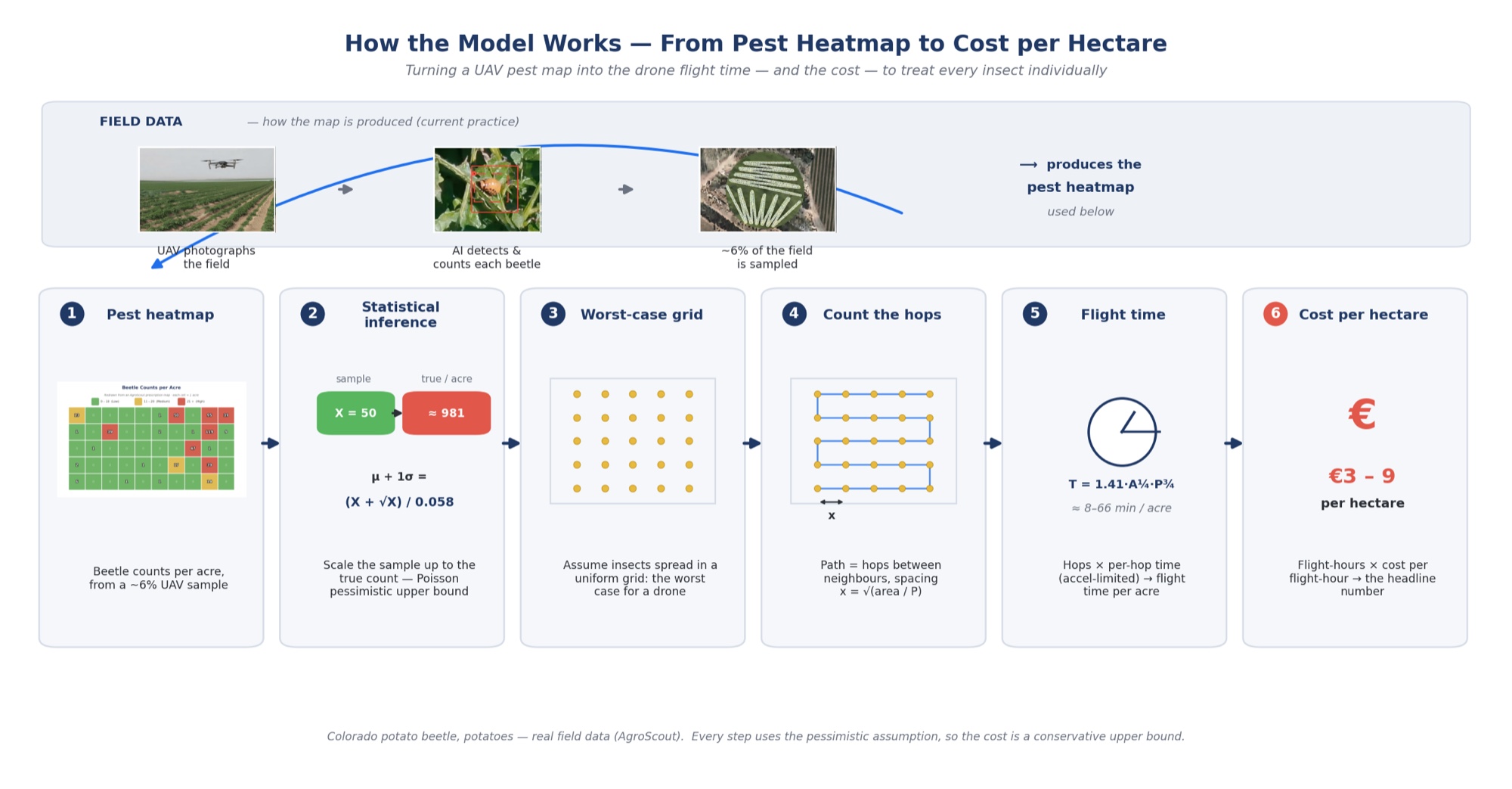
The chain of reasoning
- 1Heatmap → real counts. Convert each acre's sampled reading into the true underlying insect count — scaling the ~6% UAV sample up with a Poisson pessimistic upper bound (X + √X)/0.058.
- 2Assume the worst case. Spread those insects in a uniform grid — the hardest possible layout for a drone to traverse, so nothing is flattered by lucky clustering.
- 3Compute flight time. From the grid spacing and a conventional, gentle drone acceleration (2 m/s²), calculate the time to accelerate-and-brake between every point.
- 4Convert to cost. Turn the flight-hours into a cost per hectare at the amortised flight-hour rate.
Applied to a real 93-acre field
≈ 7 hours
€3–9 / hectare
to visit and treat every insect individually — and because every step above takes the pessimistic assumption, this is a conservative upper bound, not a best case.
Read the full paper"Empirical flight-time calculation for killing pests one at a time with a drone" · Colorado potato beetle, potatoes · real field data (AgroScout)
Follow-up // does it hold under heavy infestation?
A second field — a stress test, not a lucky one
A single favourable field proves little — the first one was only lightly infested. So the method was re-run, unchanged, on a second commercial field with 4.2× the high-pressure area: 31.7% of its hectares sit in the top (red) bucket, versus 7.5% in the first field.
31.7%
of hectares in the top bucket — 4.2× the first field
≈ 29.8 h
to neutralise the whole 60-hectare field, one insect at a time
€8.09 / ha
all-in (€1.49 neutralising + €6.60 detection scan)
Even at 4× the pest pressure the all-in cost stays roughly 1.9–6.2× below the €15–50/ha conventional chemical pass. These are model outputs under a conservative bucket-ceiling upper bound — not demonstrated operational costs — but the second field supports the case that the economics hold across a broad range of infestation, rather than being an artifact of one easy field.
As featured in // Het Laatste Nieuws & Radio 1
Just heard us on Radio 1, or read about us in Het Laatste Nieuws?
Start here. This short overview walks you through the site — what the laser drone actually does, why it kills pests without a drop of chemistry, and where to find the numbers behind every claim, all of which you can check yourself.
~$10/ha is our value-based price — set against chemical alternatives and the $25B crop we protect. The interactive model below breaks down the underlying operating cost, which is a fraction of that even across a full season. feasibility paper ↗
The evidence // interactive & verifiable
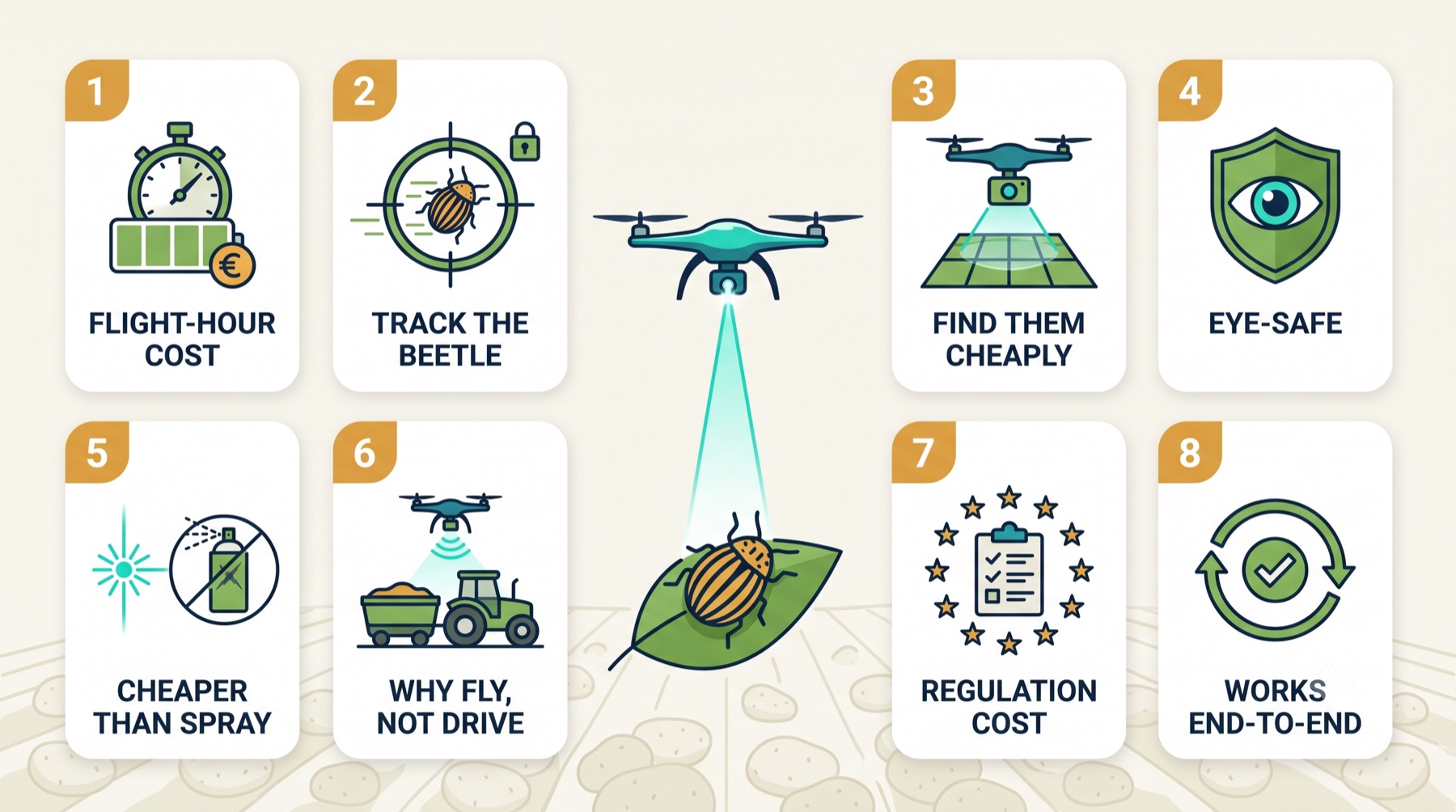
Ten questions a skeptic asks — and a model that answers each
Every answer below is an interactive model you can run yourself — and independently verify against the open-source code. Pick the one you doubt most.
1What does one drone flight-hour really cost?Battery cycles, electricity, maintenance and capital write-off, itemised — the single shared number every cost model below derives from.Explore ▾Hide ▴
Shared model // single source of truth
Drone flight-hour cost and write-off period
Everything on this page that quotes a drone cost derives it from this one calculation. The marginal flight-hour cost is what flying actually consumes — battery cycle depreciation, charging electricity and flight-dependent maintenance. Drone and equipment write-off are shown separately because airframes and electronics are capital assets whose hourly figure is an accounting allocation across expected utilisation, not physical wear per hour. Change any assumption and every dependent chart updates immediately.
Sim-calibrated: reproduces the published cost sweep exactly. 2.2 kg drone, 253 W mission average.
Marginal flight cost
€1.86/h
Ordinary drone cost (incl. capital)
€3.06/h
Fully allocated system (incl. laser)
€3.66/h
Battery / h
€0.81
Electricity / h
€0.042
Maintenance / h
€1.00
Drone capital / h
€1.20
Charger share / h
€0.00
Laser payload / h
€0.60
Battery
Energy
Maintenance (per flight-hour)
Drone write-off
A flight hour doesn't consume the airframe. If it physically lasts beyond its write-off, the one-time cost spreads over 5 yr of real life (1,500 flight-h) — lowering €/h toward the marginal rate.
Shared equipment (charger)
Optical / laser payload
Who uses what: the pest-pressure cost chart and the cart comparison price the shooting drone at the fully allocated rate; the scouting calculator prices camera-only scouts at the ordinary rate (no laser allocation); battery-replacement claims use only the battery line. Cash-flow views should exclude the non-cash capital allocations — they are labelled separately above for exactly that reason.
Recreate these numbers with Claude
Verify the drone flight-hour cost: battery €/h = price × powerW / (capacityWh × cycles); electricity €/h = powerW / chargingEff / 1000 × €/kWh; maintenance = props + motors + extra; drone capital €/h = (price − residual) / (writeOffYears × hoursPerYear); charger €/h = (price / years) / (sharedDrones × annualHours); laser €/h = (price − residual) / lifetimeHours. Marginal = battery + electricity + maintenance; ordinary = marginal + drone + charger; fully allocated = ordinary + laser. Check €180 × 253 / (140 × 400) ≈ €0.81/h.2Can a laser track and hit a moving beetle?A 2 mm beetle head at 2 m is a 1 mrad target; gimbal jitter is ~6× smaller than the kill zone, so the beam stays locked.Explore ▾Hide ▴
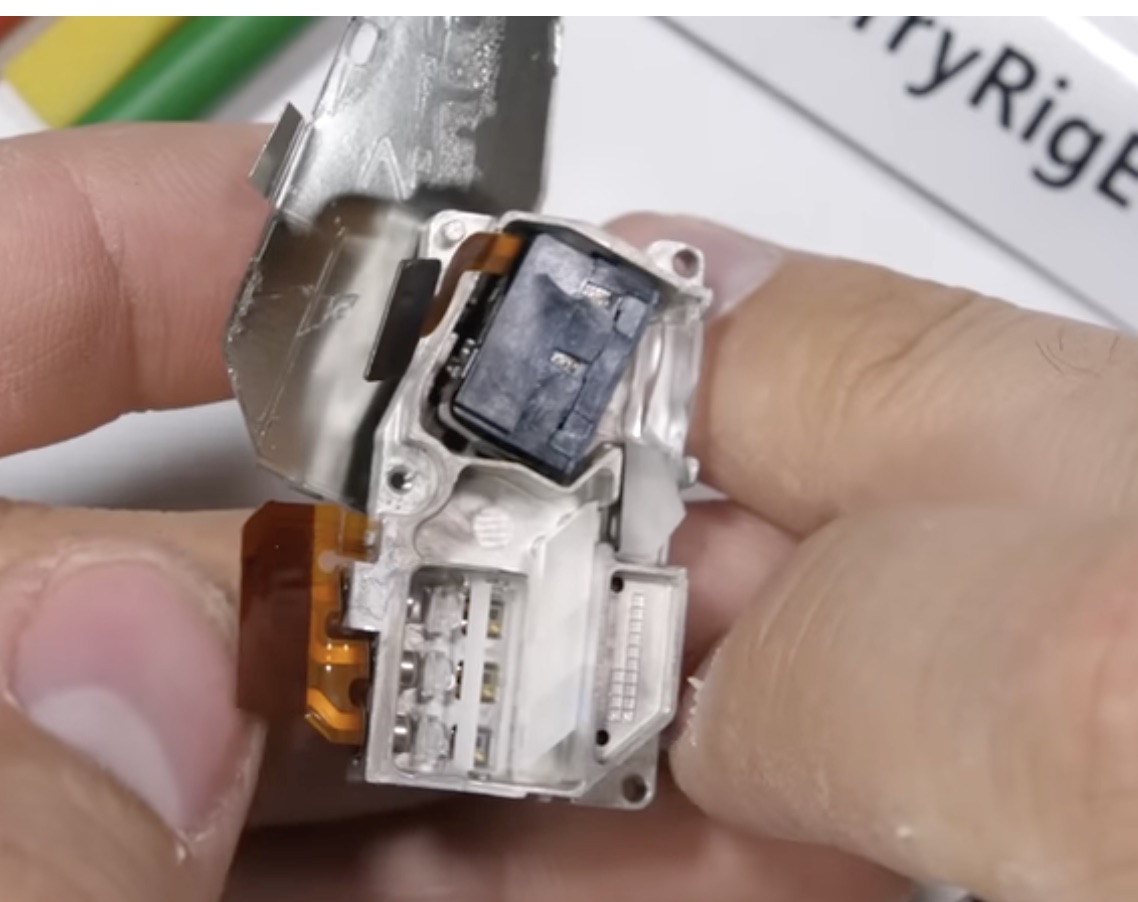
Blackview Max 1 teardown — a MEMS laser projector inside a ~$400 phone
Off-the-shelf // the aiming head already ships
A ~$400 phone already contains the hard optical part
The Blackview Max 1 (~$400 retail) has a built-in laser projector steered by a MEMS micro-mirror — the exact fast beam-steering element the aiming loop below relies on. This teardown opens the phone so you can see it: the module is tiny, and mass-produced MEMS mirrors are already a consumer commodity, not a lab exotic. Co-align a camera to that same optical path and you have most of the intended targeting head — see-and-steer in one compact assembly.
Honest scope: the projector's low-power visible laser is not the kill source. What this proves is that the cheap, compact, high-speed beam-steering — historically the part people doubt — is already in volume production.
Can it hit a walking beetle's head?
Watch the tracking loop hold the beam on a 2 mm head — live
Real dimensions, real physics, live in your browser: a 10 mm Colorado potato beetle walking at ~1 cm/s, engaged from 2 m. The camera sees it a few hundred times a second, every image arrives milliseconds late, the mirror has inertia — and the loop still pins the beam to the head, the aim point that matters.
Optical power → neutralise time
aim point ≈ 1 mm³ of water, 22→52 °C
absorbed E = m·c·ΔT
0.126 J
incident ÷ 25%
0.50 J
dwell = J ÷ W
50 ms
Heating 1 mm³ of water by 30 °C needs 0.126 J absorbed; at 25% absorption that's 0.50 J incident, delivered at 10 W in 50 ms. That is the on-target dwell: how long the beam must sit on the head to kill. The animation uses this same thermal model, so its live temperature read-out climbs at exactly this rate — its wall-clock time to neutralise is a little longer, because the loop must first acquire the moving head and then hold it. More optical power shortens the dwell, making the shot easier to land.
The beetle walks and turns; the red ring is the laser spot — transparent so you can see it held on the head. The laser only fires once the tracker holds a steady lock — then the head heats in proportion to how much of it the beam covers (the balloon shows its temperature). Past the lethal threshold: neutralized (red ring), hunt continues. Slow it down to watch the loop think: expose → find → command → settle. The render beetle is an illustrative top-down image; diagram is a schematic — the tracked target geometry is identical.
Hardware
Mirror settle time is modeled on a 7.5 mm Mirrorcle MEMS mirror; image processing is presumed to run on an FPGA.
Flight conditions
beam-on-head
…
centre within the head
beam wander (RMS)
…
of the head radius
loop delay
…
capture → mirror
kill rate
…
sim thermal model
Controller gains per preset come from the repo's automatic PID tuner — no hand-tweaking. The punchline: every combination here — including the budget rig in gusty air — keeps the beam centre on the head more than 99% of the time.
Why tracking is not the blocker
- · At 2 m, a beetle's 2 mm head is a 1.0 mrad target. Measured beam wander here is 0.06–0.14 mrad — a 4–8× margin.
- · That margin holds on a €100-class 250 fps camera: the head is a huge, slow target for modern machine vision.
- · The whole loop closes in ~3–5 ms. The genuinely hard problems are energy per kill and eye-safety — the physics covered above.
Skeptical? Good — check it yourself.
This demo runs the exact simulation from our open-source repo — same physics, same controller, vendored unchanged, parameterized with real beetle and optics dimensions. Hand it to Claude (or any capable AI) and have it re-derive the loop and reproduce these numbers.
Clone github.com/nickreyntjens/laser_drone_sim and independently validate its aiming simulation: derive the control loop (camera exposure centroid -> processing/driver latency -> PID -> second-order MEMS mirror) from src/sim/aiming.ts, run the test suite, and check the real-dimension claim: a 2 mm beetle head at 2 m range is a 1 mrad target, and a 250 fps camera with ~5 ms total loop latency keeps the beam centre on it >99% of the time (walk-mode target path, src/sim/pidTuner.ts auto-tunes the controller).3Can it find the beetles across a whole field — cheaply?Autonomous scouting is already commercial; an €800 drone resolves beetles, and the scan costs a few € per hectare.Explore ▾Hide ▴
Sim // scouting phase
What does it cost to find the beetles?
Before a laser fires, scout drones photograph the whole field to map every beetle. They hop photo-tile to photo-tile — accelerate, coast, decelerate — under a fixed acceleration limit. This is the cost of that scan.
The scouting layer isn't hypothetical — autonomous crop-scouting drones are already commercial.
This model reuses proven technology and simply adds the laser. Two of the companies deploying it today:
And it runs on tiny hardware: a peer-reviewed deep-learning pest-detection system on ultra-low-power pocket-sized drones ↗ shows on-board beetle detection is feasible on gram-scale flight hardware.
Add the laser (shooting) cost and the full operation runs $54/ha·season (scout $22 + shoot $31 at 400 beetles/ha), against a €54/ha chemical season.
A Colorado beetle is ~6–11 mm; it must span several pixels, so GSD must stay ≤ 1 mm/px. GSD = √(area ÷ megapixels): bigger photos cover the field faster and cheaper, but each pixel sees more ground — push too far and the beetle vanishes. At 48 MP you can cover up to ~48 m²/photo and still resolve it.
Photos / scan
4,000
Hop (tile 5.0 m)
2.00 s
Scan flight-hours
2.4 h
Wall-clock · 5 drones
0.5 h
More drones don't change the cost — only the speed. The total flight-work to photograph the field is fixed; extra drones just split it, cutting the wall-clock scan time. So fleet size is about meeting the 48 h patrol cadence (before the beetles can lay eggs) — 5 drones finishes with room to spare. The real cost levers are area per photo and acceleration.
Recreate these numbers with Claude
Derive the scouting flight-time from first principles: a scout hops photo-tile to photo-tile under symmetric accel/decel at limit a (t_hop = 2·sqrt(tile_side / a)), tiles = field_area / area_per_photo. Confirm cost/ha is independent of the drone count, and that flight-hours × the amortized $/flight-hour reproduces the numbers here.4Is it eye-safe near people?The beam is lethal only at its focal point and fans out fast — eye-safe within a few metres.Explore ▾Hide ▴
Is the laser safe?
How far away is it eye-safe?
The beam is a tight, lethal point on the beetle. A short distance past it, the beam has fanned out so much it can't harm an eye — here's where that line is.
The exposure isn't guessed — at 10 W a lethal hit needs about 50 ms of dwell to heat the beetle's head to 52 °C, and that's the exposure this eye-safety distance assumes. Turn the power up and the dwell — and the exposure per shot — drops.
That dwell comes from one deliberately basic model: the aim point is 1 mm³ of water heated 22→52 °C, so the absorbed energy is just m·c·ΔT ≈ 0.126 J. Only 25% of the beam couples in — the paper's measured cold-cuticle absorption at 1550 nm, held flat for the whole shot — so the beam must deliver ≈0.5 J. There is no heat-loss term, no charring uplift and no fudge factor: four constants and two divisions, so you can check it by hand.
The steering optics are sized to a 7.5 mm MEMS mirror — the mirror is the beam's exit aperture, so its size sets the divergence this eye-safe distance is derived from. That figure is the expected optic based on Mirrorcle's MEMS mirrors.
Notice the safe distance doesn't move when you change power — and that's real, not a stuck slider. A lethal shot delivers the same energy at any power (more power just fires faster, shortening the dwell), and at 1550 nm the eye's damage threshold is a fixed dose over these dwell times — so the two exactly cancel. Power sets speed and cost; eye-safety comes from the optics and geometry, not the power.
The dials that do move it: a bigger lens starts the beam wider, so it focuses harder and then fans out faster — the danger zone gets shorter. That's the main dial for making the system safe near people. A closer kill point (shorter focal distance) does the same.
Skeptical? Good — check it yourself.
This isn't a number to take on faith. The calculator is open source: hand the repo to Claude (or any capable AI) and ask it to re-derive the optics from first principles and reproduce every value here. Independent verification in under a minute.
Clone github.com/nickreyntjens/laser_safety_calculator.py and independently validate it: derive the Gaussian-beam nominal ocular hazard distance from first principles, confirm the tool's numbers (~6 m at 10 W, 1550 nm, M²=2, f=1 m, 2.5 mm input radius), and check the safe distance shrinks as the input beam radius grows.5Is it cheaper than chemicals?Marginal cost per hectare is negligible; even a full season undercuts a chemical-spray program.Explore ▾Hide ▴
Sim output // cost model
What laser pest control really costs
15 simulated missions · seed 17
Unit costs — airframe €1,800, laser €6,000, battery, electricity, maintenance (3.66 €/flight-h fully allocated) — come from the . Adjust them there and this chart updates live. (The peer-reviewed paper projects €2,000–5,000 for airframe + laser hardware.)
Cost at this pressure$1.78/ha·sweep· scouting + shooting
total $1.78/ha·sweep
scan $0.75 · amort $0.80 · batt $0.23 · elec $0.012
10 ha: 2.8 flight h · 6 recharges / sweep
pest pressure — beetles/ha · drag the slider above or hover the chart
▚ The field at 400/ha
~4,000 beetles invade from one edge and thin out exponentially with depth; uniform across the width. Poisson-sampled, so the count varies run to run.
Real physics
Flight energy from momentum-disk theory — 2.2 kg all-up mass (incl. 0.7 kg battery), rotor area, drag. No fitted curves.
Poisson-sampled fields
Beetle counts drawn from a Poisson distribution: independent random arrivals at a mean density, like a real infestation.
Scout, then shoot
The full cost = the scouting scan (finding the beetles) + shooting, priced at the shared flight-hour rate: capital write-off + maintenance + battery wear + electricity, all set in the shared panel above.
Recreate these numbers with Claude
git clone https://github.com/nickreyntjens/laser_drone_sim
"Run scripts/costSweep.ts across pest pressures 100-2000 on the default 10 ha potato field and explain the cost-per-hectare breakdown (amortization, battery, electricity) with and without the neonicotinoid border."
open the open-source simulator ↗6Why fly — wouldn't a ground robot be cheaper?A tractor-pulled laser cart amortises a €200k–1.1M machine plus fuel and two operators over slow coverage; against the drone's own cost-per-hectare figure it lands over 5× more expensive.Explore ▾Hide ▴
Sim // ground vs air
Why fly? Ground laser cart vs laser drone, per hectare
The other way to kill pests with light is to drive a heavy laser rig through the field on a tractor. This calculator models that ground cart in full — machine, tractor, fuel, operators — and compares it against the drone, whose €/ha is taken directly from the drone cost-per-hectare model above (not recomputed here). Capex is included on both sides.
Field-scale agricultural lasers already exist — on the ground.
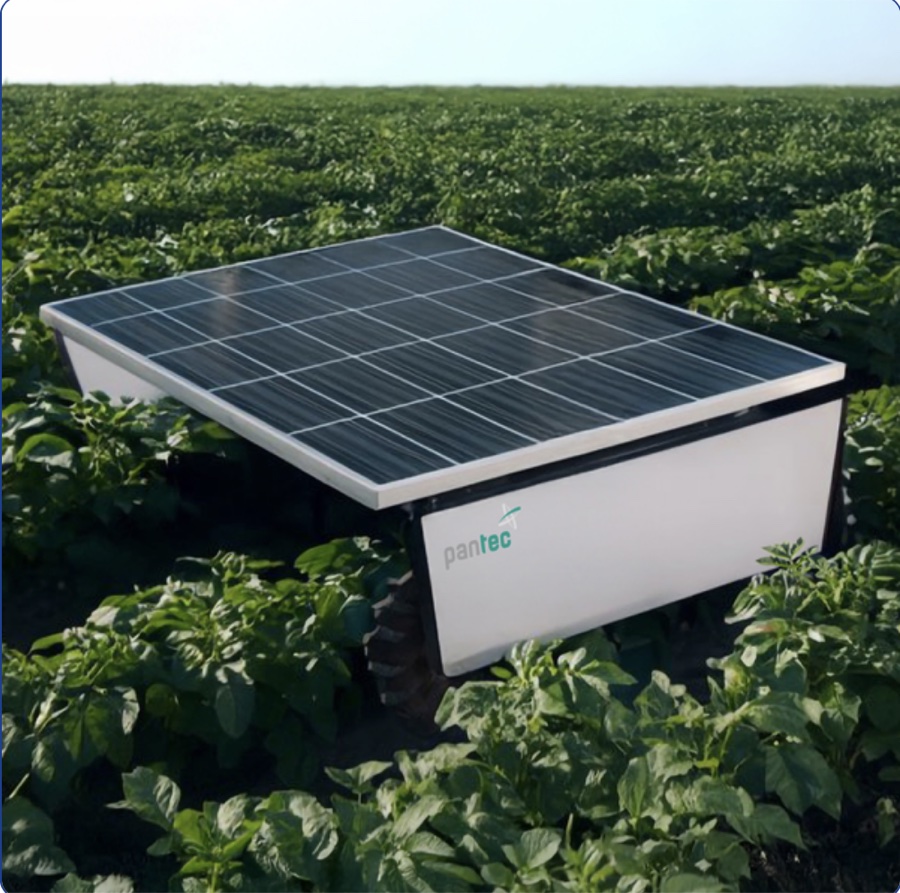
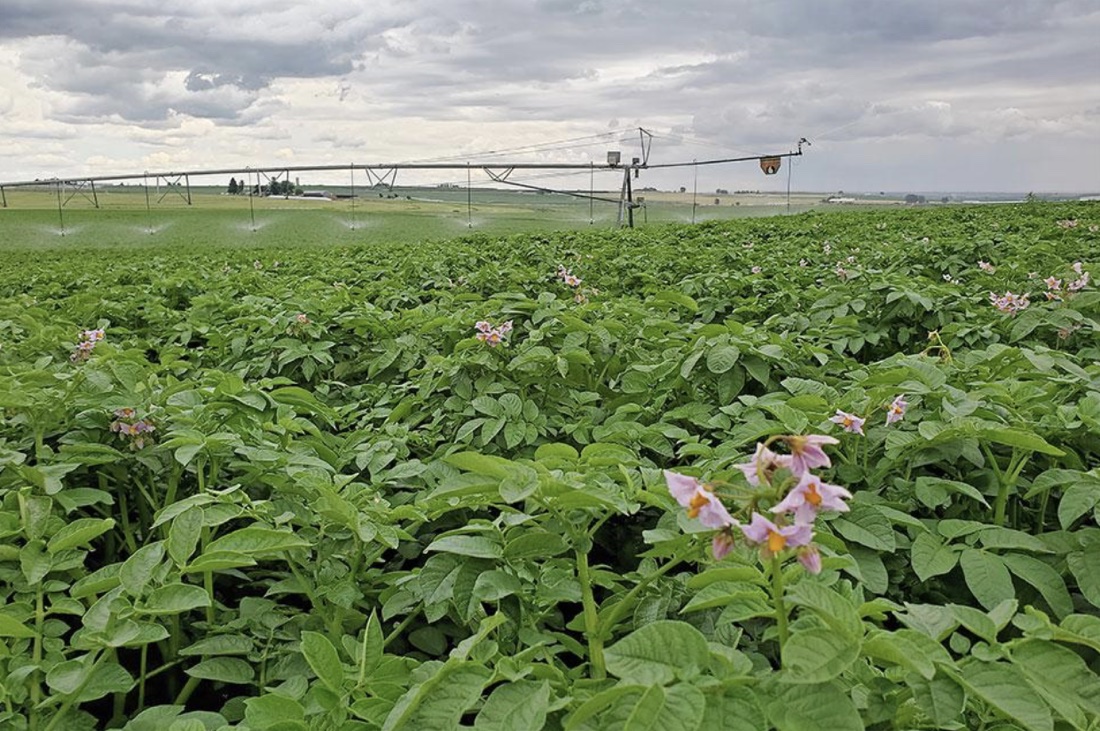

Ground cart
€301.90
/ha·season
−82%
drone is
5.6× cheaper
Laser drone
€53.55
/ha·season · from the model above
| €/ha·season | Ground cart | Laser drone |
|---|---|---|
| Coverage rate | 1.46 ha/h | autonomous 24/7 |
| Fixed capex | €85.71/ha | €23.86/ha |
| Variable | €216.19/ha | €29.69/ha |
| Total | €301.90/ha | €53.55/ha |
Fixed capex · €/ha·season
Ground cart
Laser drone
Variable · €/ha·season
Ground cart
Laser drone
Ground cart — adjust
the drone side is fixed (from the model above)The cart isn't wrong — it's just heavy. Its cost is dominated by a six-figure machine plus a tractor, fuel and two operators grinding through the field at a few km/h. The drone carries none of that: no operator, negligible energy, and an airframe that is a rounding error next to a €200k–1.1M rig. Even before the drone's finer targeting, the economics alone favour flying.
The cheapest way to do a job is almost always the smallest tool that can actually do it — anything bigger is hauling mass, and cost, the work never asked for. A few-hundred-gram drone that flies to each beetle is that tool; a tonne of steel dragging a laser through the mud is not.
Recreate these numbers with Claude
Compute lifetime €/ha·season for a tractor-pulled laser weeder: work-rate = width×speed×efficiency/10 ha/h; hourly OpEx = tractor + fuel(L/h×€/L) + operators×labour + consumables, ÷ work-rate = €/ha·pass; fixed = machine depreciation (price−salvage)/life/annual_ha only; total = fixed + passes×per-pass. Take the DRONE €/ha·season straight from the drone cost-per-hectare model (400 beetles/ha, €2,000 airframe, full 30-sweep season) and confirm the cart lands far above it.7What does EASA regulation add per hectare?BVLOS compliance is a few € per hectare on one hub, and collapses toward zero under a fleet-wide LUC as the cooperative scales.Explore ▾Hide ▴
Sim // regulation
What does EASA compliance cost per hectare?
Flying autonomous BVLOS (beyond visual line of sight) under EASA's PDRA-G03 pre-defined risk assessment — low-altitude agricultural ops in sparsely-populated areas — carries fixed compliance overhead. On a single hub that's a few euro per hectare; across a cooperative under one fleet-wide licence it collapses toward zero. This is regulatory cost only — it sits on top of the operating cost in the other calculators.
6.3×
LUC is
lower at 10 hubs
regulatory €/ha·year vs cluster size — docks in the cooperative
Ha / dock
495 ha
Total cluster
4,948 ha
LUC cost / yr
€4,342
LUC wins past
2 hubs
Compliance is a fixed cost, and fixed costs love scale. One SORA authorization per hub never gets cheaper per hectare. But a single fleet-wide LUC — one platform operator running many regional docks — spreads the same paperwork across the whole cooperative, so at 10 hubs the regulatory burden is €0.88/ha·yr and still falling. Above 2 hubs the LUC is the cheaper route.
Recreate these numbers with Claude
Model EASA PDRA-G03 BVLOS drone-in-a-box regulatory cost/ha. Per-hub SORA annual = application/amort + surveillance + consulting/amort + insurance; one dock reaches π·r²·100·coverage ha, so per-hub €/ha is flat. A fleet-wide LUC (setup/amort + renewal + consulting/amort + insurance) covers ALL docks, so its €/ha = luc/(docks·ha_per_dock) decays ~1/N. Confirm LUC overtakes per-hub above ceil(luc/perHub) docks.8Does the whole system work end-to-end?Run a full autonomous mission — scout, plan the route, aim, fire — in the browser.Explore ▾Hide ▴
9Can I check the energy numbers by hand?The simplified counterpart to the 3D engine above: tilt the thrust vector, hop, multiply. Four equations, no hidden state — and it shows flying flat-out is not the cheapest way to cross a field.Explore ▾Hide ▴
Simplified sim // check it by hand
Vector model: how deep is the infestation, and what does that cost?
The 3D simulator above is a full physics engine — powerful, but you have to trust it. This is its stripped-down counterpart, equations you can check on paper. Beetles invade from the edges, so each 1 m slice of perimeter has a depth line running D metres into the crop with x beetles evenly along it. The drone flies a serpentine — down a line, one metre across, back up the next — so there are exactly two hop lengths: D/x and 1 m. A hop is accelerate-then-brake at a tilt, so power × time gives the joules. Nothing is estimated.
at the energy optimum
18% of all energy is spent hovering to shoot
sets the vectors in newtons — the energy depends on the thrust ratio, so this alone doesn't move it
square · 100 m a side · 400 m perimeter
in each 1 m × 5 m slice · 800 beetles in total
band covers 19% of the field · 0.19 ha
a real DJI Mini pack, matching the 250 g / 40 W figures above
Power law
Momentum theory is the physics the main simulator validates against real DJI M100 telemetry. The naive law is the intuitive first guess — at these settings it under-states the total by 7.9%.
Tilt
35.3°
thrust 1.225× hover
Power while hopping
54.2 W
hover is 40 W
Mean hop
1.75 m
2.50 m down the line, 1.00 m across
Pest pressure
800/ha
4,211/ha inside the band
Energy to clear the whole band
14.47 Wh
14.47 Wh/ha · 17.1 min · 80% of the 18 Wh battery
≈ €1.04/ha at the shared flight-hour rate of €3.66/h× 30 sweeps a season = €31.19/ha·season — against ≈€54/ha for a chemical spray programmecounting only battery wear: €0.047/ha × 30 = €1.40/ha·season14.47 Wh at €3.21 per kWh of pack throughput (the shared pack price ÷ its lifetime energy) — the consumable floor, before any capital or maintenanceThis floor is reachable in practice because the airframe itself is cheap: the off-the-shelf components add up to about €100, and the only part that genuinely wears is the motor bearings (~€0.20 each). With the logistics in place to swap bearings on a schedule and treat frames as crash spares, the running cost really does collapse toward the energy.the fully-allocated rate prices the 2.2 kg reference drone from the first model on this page, so treat it as indicative for a 250 g machine
Energy per hop vs acceleration
There is a genuine minimum at a/g = 1/√(2k−1) = 0.707 g. Flying flat-out is not the cheapest way to cross a field.
Where the beetles are
drag the field to move the zoom
Infestation
800 beetles/ha
2 beetles in each 1 m × 5 m slice of a 400 m perimeter is 800 beetles over 1 ha. For scale, the pest-pressure cost chart above spans 100–2,000 beetles/ha.
Infested band
0.19 ha
19% of the field
Local density
4,211/ha
0.42 per m² in the band
The two levers pull opposite ways. More beetles per slice adds targets and packs them closer, so hops shorten. More depth adds no beetles at all — it just spreads the same ones thinner, so hops lengthen. Deeper infestation is therefore more expensive per beetle, which is why catching it early, while it is still a shallow edge band, is worth money.
tilt θ = atan(a/g) = atan(0.707) = 35.26°
|T|/|T_hover| = √(1 + (a/g)²) = 1.2247
P = 40 W × 1.2247^1.5 = 54.21 W
band = S² − (S−2D)² = 100² − 90² = 1,900 m²
beetles = 400 slices × 2 = 800
down the depth line: D/x = 5 / 2 = 2.500 m → t = 1.2008 s → 65.10 J
across to the next slice: 1 m → t = 0.7594 s → 41.17 J
E_dwell = 40 W × 0.30 s = 12.00 J per beetle
per slice = 1×65.10 + 41.17 + 2×12.00 = 130.27 J
× 400 slices = 52,106 J = 14.47 Wh
What this deliberately leaves out: aerodynamic drag (justified — at ~1 m hops the peak speed is ~3 m/s and drag is well under 1% of hover power), translational lift, wind, climb and descent, battery sag, and the time to find the next beetle. The route is assumed to be a clean serpentine — down each depth line, one metre across, back up the next — so the two hop lengths are exact rather than estimated. Real beetles will not sit that tidily, but the arithmetic is then something you can redo on paper in a minute. It is a floor on the travel energy, not a mission plan.
Recreate these numbers with Claude
Check this from first principles. (1) A drone holds altitude while accelerating horizontally at a, so thrust = m·√(g²+a²), tilt = atan(a/g), and the thrust ratio vs hover is √(1+(a/g)²). Power P = P_hover × ratio^k with k=1.5 (actuator-disk momentum theory) or k=1 (naive). (2) A hop of distance d is symmetric accel/decel with no drag: t = 2√(d/a); since |a| is the same in both halves the power is constant, so E = P·t exactly. Show energy per hop is minimised at a/g = 1/√(2k−1). (3) Beetles invade from the edge: each 1 m slice of perimeter has a depth line running D metres into the crop, with x beetles evenly along it, so beetle k sits at (k+½)·D/x. The drone flies a serpentine — down one line, 1 m across, back up the next — giving exactly (x−1) hops of D/x plus one hop of 1 m per slice, i.e. one hop per beetle. With 4S slices, confirm the totals and that the mean hop is ((x−1)·D/x + 1)/x.10Beyond cost — what else is a chemical-free hectare worth?Blight resistance via true seed, EU eco-scheme subsidy, avoided compaction and a residue-free premium — tiered by evidence and cited.Explore ▾Hide ▴
Value // beyond the cost saving
What else is a chemical-free hectare worth?
The cost model above shows the drone undercuts chemical spraying. But removing chemistry from the field unlocks value beyond the input saving. Every euro below is tiered by evidence strength and carries a citation — the moats that resist a clean €/ha are listed, not summed, so the headline stays defensible.
Monetised secondary value
€774/ha
on top of the ~€44/ha direct spray-vs-laser saving · plus the moats below (unpriced)
Tier A · hard, referenced — €444/ha
Tier B · modest, real — €330/ha
Where the €774/ha comes from
Tier C · moats worth real money, hard to price — not summed
✓ Resistance-proof
A physical kill can't be evolved against — efficacy is a permanent asset, unlike chemistry, which the beetle defeats class by class.
✓ No spray drift
No off-target damage, neighbour-crop liability, or sacrificed buffer-zone yield.
✓ No by-kill
Pollinators and beneficials are spared — this is what earns the biodiversity-insetting premium above.
✓ Weather-independent
No wash-off, UV degradation, or drift-forcing wind windows: act on the optimal day, not the sprayable day.
✓ No re-entry interval
No PPE, no re-entry delay, no operator chemical exposure (the childhood-exposure externality).
✓ Avoided carbon
No emissions from insecticide manufacture or diesel spray passes — potential carbon / Scope-3 value for buyers.
✓ No water contamination
No pesticide runoff or leaching — regulatory and water-framework value.
Kept honest: the TPS blight value only applies to True-Potato-Seed growers. The compaction figure is the mainstream European estimate — some sources claim a far higher "compaction tax," which we don't bank. And a laser does not confer organic status (that needs the whole system chemical-free, with a ~30–50% yield penalty a laser can't remove) — so we count a modest residue-free premium, not a full organic markup.
Seminal Paper Presentation at SPIE Photonics Europe
The Vrije Universiteit Brussel (VUB) Photonics department will present the research paper "A UAV photonics-based humane method for the elimination of agricultural pest insects: A Colorado potato beetle case study" at the SPIE Photonics Europe convention in Strasbourg.
EU-Funded Research
This feasibility study is complementary to an EU-funded Photonics Technology Innovation project under PhotonHub Europe — the pan-European one-stop-shop for photonics innovation funded by the European Union.



Field Log // Proof of Concept
Technology in Action
A 50-watt, 450 nm laser — first airborne on a drone, then demonstrated on a live Colorado potato beetle, and finally focused for maximum lethality. All achieved on a limited budget, yet sufficient to remove key presumptions about feasibility.
What these clips actually de-risk — and what they don't
Every hard physical unknown behind this project is demonstrated below in isolation, on real hardware and real fields — not renders. Each clip removes one presumption:
- The laser is real and lethal. “Laser vs. Colorado Beetle” — a 50 W, ~250 g module kills a live beetle on the bench. Isolates the optics and the kill; not yet on a drone.
- It flies as payload. “50W Laser Drone in Flight” — that class of laser airborne on a multirotor. Carried and fired, but with no aiming mechanism yet.
- The beetles can be found. “Colorado Beetle Larva Tracking on a Real Field” — AI detects and tracks beetles in actual crop footage. This is the real detection input the control loop needs.
- Pointing can be stabilised. “Stabilized Laser on Drone” — a MEMS mirror holds the beam on a fixed spot against airframe motion.
What is not yet shown is the three closed on one flying platform at once — detect → aim → fire. That remaining step is integration, not a new physical unknown, and it is exactly the closed loop the simulator above models. Each piece is proven; the assembly is the work ahead.
Stabilized Laser on Drone
A MEMS mirror compensates for the drone's motion, keeping the laser pointer locked on a single spot.
Colorado Beetle Larva Tracking on a Real Field
Real-field tracking of Colorado potato beetle larvae — detection and targeting in actual crop conditions.
50W Laser Drone in Flight
A drone flying with a 50-watt, 450 nm laser onboard. The prototype drone did not have aiming, but a DJI drone with gimbals can achieve ±0.01° jitter when stabilizing a camera — concretely, that means a beam held within 0.17 mm at 1 m.
Laser vs. Colorado Beetle
The same 50W laser, stationary on the ground, neutralising a Colorado potato beetle.
Focused Laser Lethality
Colorado Beetle Larva vs. 5W Laser
Drone Prototype Flight Test
Lightweight Laser System
Tracking Multiple Beetles
Event Camera Beetle Detection at 500 FPS
Colorado beetles recorded by an event camera at 500 fps — no motion blur enables field scanning at speeds up to 50 km/h.
Colorado Beetle Distribution in Field
Reference Optical Architecture (FoveaCam+)
A reference optical architecture for high-resolution insect tracking — only an appropriate laser module needs to be added.
Foveated Imaging — a wide view and a magnified one at once
The same trick the eye uses: a wide field to spot movement, and a narrow high-resolution fovea steered onto whatever matters. It is why a scout does not need survey-grade resolution across the whole frame — only over the target it has already found.
Alternative: Precision Micro Spraying & Electrocution
An alternative approach that enables precision micro spraying or direct neutralization through electrocution.
Future Concept
22,580 Drones from a Single Computer
The world record for the most multirotors airborne simultaneously from a single computer — 22,580 drones (EHang, Hefei, 3 Feb 2026).
Peer-reviewed // SPIE
What the peer-reviewed paper establishes
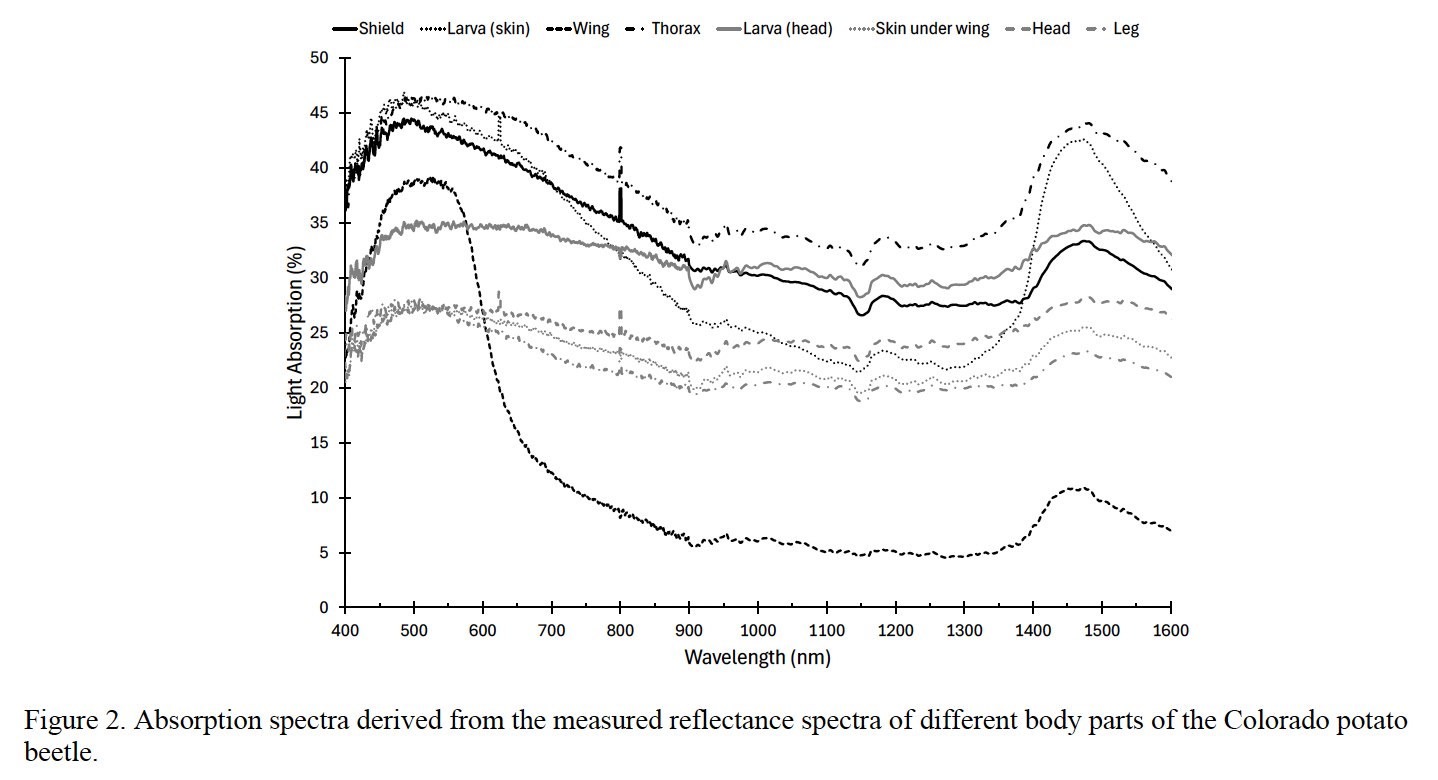
None of this is a company white-paper. The work is published at SPIE, co-authored with VUB Brussels Photonics (W. Meulebroeck, H. Thienpont) and Flanders Make, funded through the EU PhotonHub / Horizon 2020 programme (GA 101016665); the beetle spectroscopy was done at Ghent University (Prof. K. De Schutter). Each hard claim behind the simulator is measured, ray-traced or bench-tested in it:
Lethality, in vivo
A 50 W laser carbonizes an adult beetle's sclerotized elytra at 1 m — immediate, confirmed mortality. Larvae rupture at just 5 W. This kill used the 450 nm bench laser; the eye-safe 1550 nm build (similar ~25% absorption) is the next step.
Optics, ray-traced
A full Ansys Zemax design focuses to a 0.34 × 0.15 mm spot at ~99% throughput across the whole ±7.5° MEMS scan.
Eye safety, to standard
An IEC 60825-1 analysis puts a 10 W, 1550 nm system's human-exclusion zone at ~2.1 m — eye- and skin-safe beyond it.
Airborne hardware
A <300 g, 50 W laser payload was flight-tested on a <1 kg quadcopter; the steering mirror survived repeated firing.
Detection
Beetles sit exposed on the upper canopy and are found by vision at 0.5–1 mm ground resolution — undisturbed by prop wash.
Economics & regulation
~$10.68/ha per season vs ~$54/ha for chemicals, in the low-risk Open (A1) drone category — no two-person spray-drone crew required.
Download our rough market estimation (ZIP — suitable for analysis with Gemini or similar AI) to verify that the total addressable market for Colorado potato beetle control is approximately $80 million, for yellow stem borer around $600 million, and the value of the potato crop under protection is roughly $25 billion.
🥔 True Potato Seed & Late Blight
The Colorado potato beetle is currently a critical obstacle for True Seed potato farming — a breakthrough approach that solves late blight, the single biggest problem in potato cultivation worldwide. By enabling chemical-free beetle suppression, photonic insecticides become a missing enabling component for late-blight-resistant True Potato Seed systems.
📎 Open Research Gaps
This field is still in its early stages and many fundamental research questions remain open — from optimal wavelength selection and real-time target acquisition to ecological impact assessment and autonomous navigation in crop canopies. PhD students and academic researchers are warmly invited to explore these gaps. Feel free to get in touch to discuss collaboration or thesis topics.
Drone components // off-the-shelf
The parts, and what they cost
Nothing here is bespoke. These are catalogue parts at single-unit prices, linked to a live supplier listing so the figures can be checked rather than taken on trust. What matters for operating cost is not the sticker price but the last column: only one of these ever wears out.
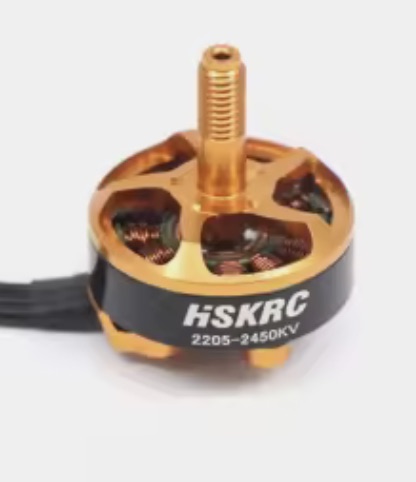
Brushless motor
€52205, 2450 KV, 3–6S · 4× per drone = €20
does not wear outNo brushes and no commutator, so nothing rubs except the bearings. Replace those and the motor is as new.
view supplier listing ↗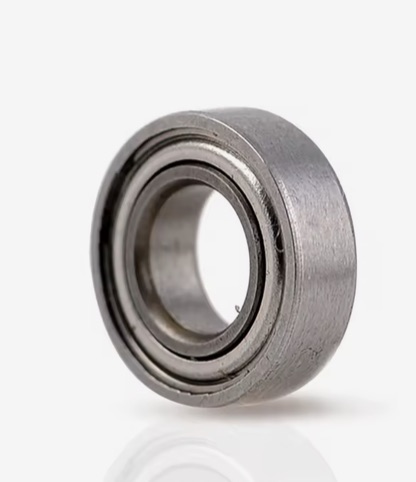
Bearing
€0.20shielded miniature, 2 per motor · 8× per drone = €1.60
consumableThe only part with a genuine wear mechanism — the one moving contact in the whole drivetrain.
view supplier listing ↗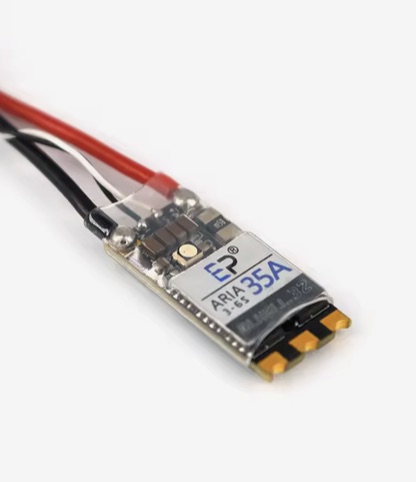
ESC
€1835 A, AM32, 3–6S · 4× per drone = €72
does not wear outSolid state. It fails from heat, vibration or a crash — never from hours flown.
view supplier listing ↗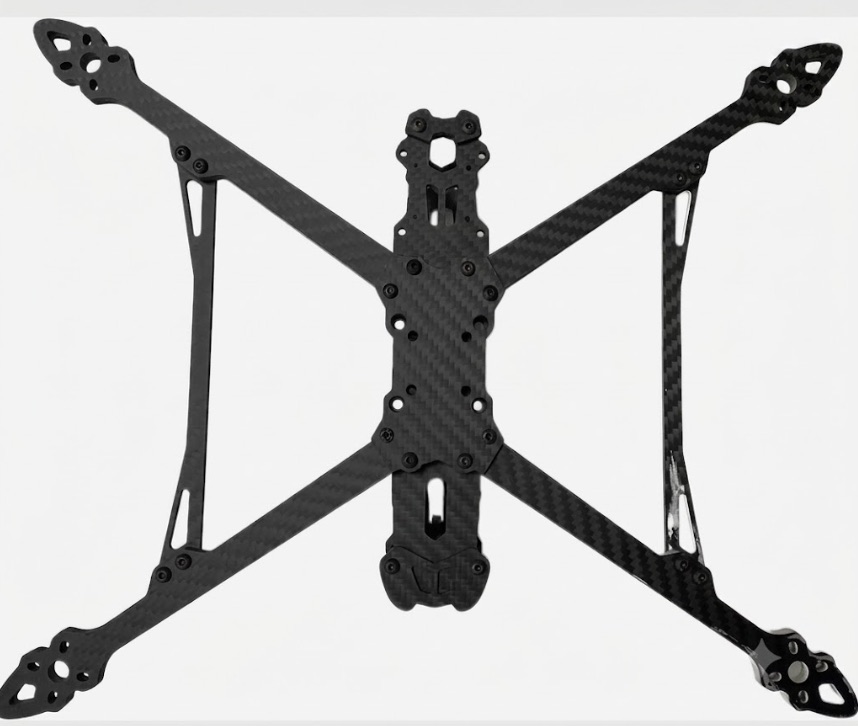
Frame
€105" carbon fibre, AS9100D · 1× per drone = €10
crash spareCarbon does not fatigue at these loads. Arms break in crashes, so budget for accidents rather than for hours.
view supplier listing ↗Only the bearings are a running cost
A brushless motor has no brushes and no commutator — the rotor never touches the stator. The single moving contact in the entire drivetrain is the pair of bearings in each motor, and those cost €0.20 each. Replacing all eight restores four motors to as-new for €1.60, which is under a third of the price of one new motor.
The ESCs are solid state — they have no wear mechanism at all. They die from heat, vibration or a crash, not from hours flown. The frame is the other thing you will buy again, but as a crash spare rather than a consumable: carbon does not fatigue meaningfully at these loads, it just snaps when you hit something.
So the honest maintenance picture is bearings on a schedule, frames after accidents, and everything else until it breaks. That is a very different cost shape from a sprayer, where the consumable is the chemical itself and it is gone after every pass.
Excludes flight controller, receiver, propellers, battery and the optical payload. Prices are single-unit supplier listings in mid-2026 and will move; the links are there so you can check them rather than believe them.
Threat Report // Chemical Insecticides
The Insecticide Crisis
Chemical insecticides are causing irreversible damage to our planet. Scientists worldwide are calling for immediate action.
Chemical Toxicity
Traditional insecticides harm beneficial insects, pollinators, and ecosystems.
Soil Degradation
Chemical runoff destroys soil quality and contaminates water sources.
Massive CO₂ Emissions
Chemical production and application contributes significantly to climate change.
Ecosystem Collapse
Loss of pollinators threatens food security and biodiversity worldwide.
Countermeasure // Photonics
The Photonic Solution
Laser-based precision technology that targets pests without harming the environment. The sustainable future of agriculture.

Precision Targeting
Laser technology eliminates only harmful pests, protecting beneficial insects and pollinators.
Zero Chemicals
No soil contamination, no water pollution, no harm to ecosystems.
100× Lower Emissions
Reduces CO₂ emissions by two orders of magnitude compared to chemical production.
Safe & Scalable
Eye-safe laser technology verified by VUB photonics department, ready to scale.
No Soil Compaction
Lightweight drone deployment preserves soil structure — no heavy machinery over fields.
Super Lightweight Drone
No need to carry 30 kg of chemicals — a compact photonic unit keeps the drone light and agile.
"Photonic insecticides are a real solution to the problems of chemical insecticides. Safe, super energy efficient, and easy to scale. Sustainable laser-based technology for insect pest control is the future."
Economic Efficiency: We price at a ~$10/ha value basis — competitive with conventional chemicals — while our simulated operating cost runs well below that, capturing the premium value of sustainable, chemical-free agriculture. Explore the underlying numbers in the interactive cost model above.
The Missing Link
Late Blight & True Potato Seed
Photonic insecticides are the critical enabling component for True Potato Seed systems — connecting beetle control to the billion-euro late blight problem.
TPS Vulnerability
True Potato Seed offers a genetic solution to Phytophthora infestans (Haynes et al., 2022), but its fragile seedlings are highly vulnerable to the Colorado Potato Beetle (Martin, 1988).
Photonic Protection
Autonomous laser drones provide non-chemical, precision defence for these delicate seedlings — eliminating the beetle threat without harming the crop.
Unlocking Blight Resistance Value
By safeguarding TPS seedlings, the technology unlocks the massive economic value of blight resistance — estimated at €1,000–€1,500/ha in NW Europe (Europatat Action Plan, 2024; NEPG, 2024).
Late blight costs European potato farmers billions annually. TPS varieties resist the disease genetically — but only if their seedlings survive the beetle. Photonic insecticides close this gap, turning a laboratory breakthrough into a field-ready reality.