
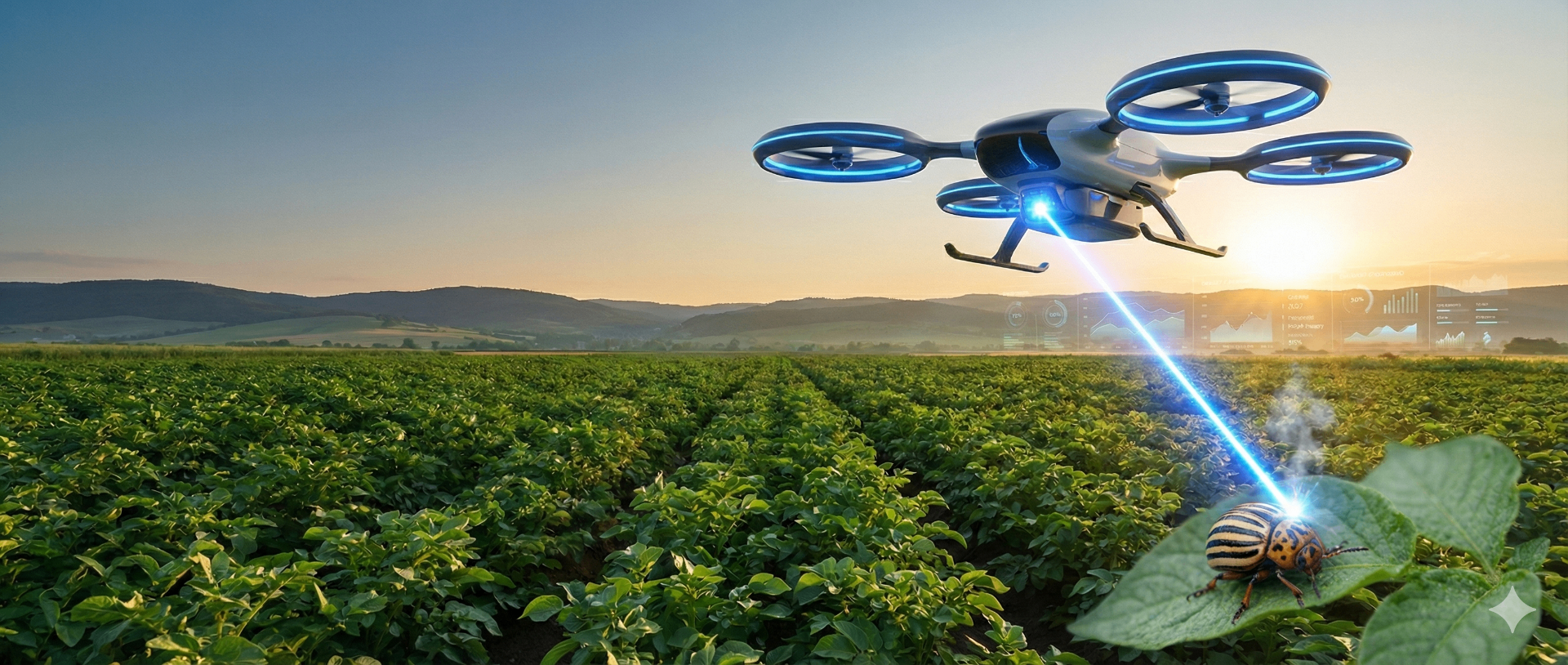
 Concept art
Investment Opportunity
The $36B Case for Photonic Pest Control
Regulatory pressure is phasing out neonicotinoids. Chemical alternatives cost up to $200/ha. Our operational cost is ~$10/ha — and we price against alternatives, not our cost base.
Regulatory Tailwind
Regulatory Disruption & Competitive Advantage
Neonicotinoid exemptions survive only because no viable alternative exists. Autonomous photonic insecticides change that equation entirely.
The Neonicotinoid Loophole
Emergency neonicotinoid exemptions currently hinge on a "lack of viable alternatives" — biologicals like Bt and nematodes fail due to weather instability and inability to control adult pests (EASAC, 2023).
The Photonic Disruptor
Autonomous photonic insecticides are weather-independent and effective across all life stages — invalidating the regulatory defense that keeps neonicotinoid exemptions alive.
Outcompeting Biologicals
Biological control programmes cost up to €200 per hectare (Alyokhin et al., 2012). Photonic solutions deliver superior control at lower cost with no environmental dependencies.
Once a credible, weather-independent, all-life-stage alternative exists, the legal basis for neonicotinoid emergency exemptions collapses. Photonic insecticides don't just compete — they reshape the regulatory landscape.
Market Forces
The Old Model is Broken. The Future is Photonic.
Developing a single new chemical insecticide now costs ~$300 million and takes over a decade — only for pests to develop resistance in a few years. We replace expensive, single-use molecules with reusable, directed energy that is immune to resistance and bypasses the regulatory bottleneck.
The market is demanding a $36B non-chemical revolution — we are building the hardware to deliver it.
$36B+ Market Gap
The global biopesticide & non-chemical market is surging, shifting from recurring chemical costs to scalable tech platforms.
Regulatory Squeeze
The EU Green Deal targets a 50% pesticide reduction by 2030, creating forced demand for non-chemical alternatives.
Resistance Crisis
Pests evolve resistance faster than new chemicals are invented. Directed energy is immune to biological resistance.
Proven Precedent
Carbon Robotics raised $157M+ for laser weeding — proving laser agriculture is a fundable category. Pests are the next frontier.
Business Model
Business Model
A subscription-based "No Cure, No Pay" model that aligns our success with farmers' outcomes.
Subscription Model
Seasonal drone-as-a-service subscriptions — farmers pay per hectare per season. No upfront hardware cost, no commitment beyond the season.
Operational Cost
Estimated operational cost: ~$10/ha. Energy cost is negligible — the main cost driver is battery depreciation. This is our cost base, not what we charge.
No Cure, No Pay
Performance-based pricing. If the pests aren't controlled, the farmer doesn't pay. This eliminates adoption risk.
Unit Economics
Margin Architecture
Our pricing is not cost-plus. We price against the cost of alternatives and the value we deliver — creating exceptional margins as chemical costs rise.
Cost vs. Price vs. Alternatives
As neonicotinoid bans expand, the cost of chemical alternatives rises — widening our margin potential without changing our cost base.
Value-Based Pricing
We don't price at cost. Our price is set below what growers currently pay for chemical pest control — delivering savings to them while capturing substantial margins for us.
Expanding Margin Tailwind
As regulations phase out cheap neonicotinoids, chemical alternatives get more expensive. Our cost base stays flat — margins expand automatically with regulatory pressure.
Organic Premium Upside
Chemical-free protection enables organic certification. Organic produce commands 20–100% price premiums — creating additional willingness to pay.
Intellectual Property
A Deep & Defensible IP Moat
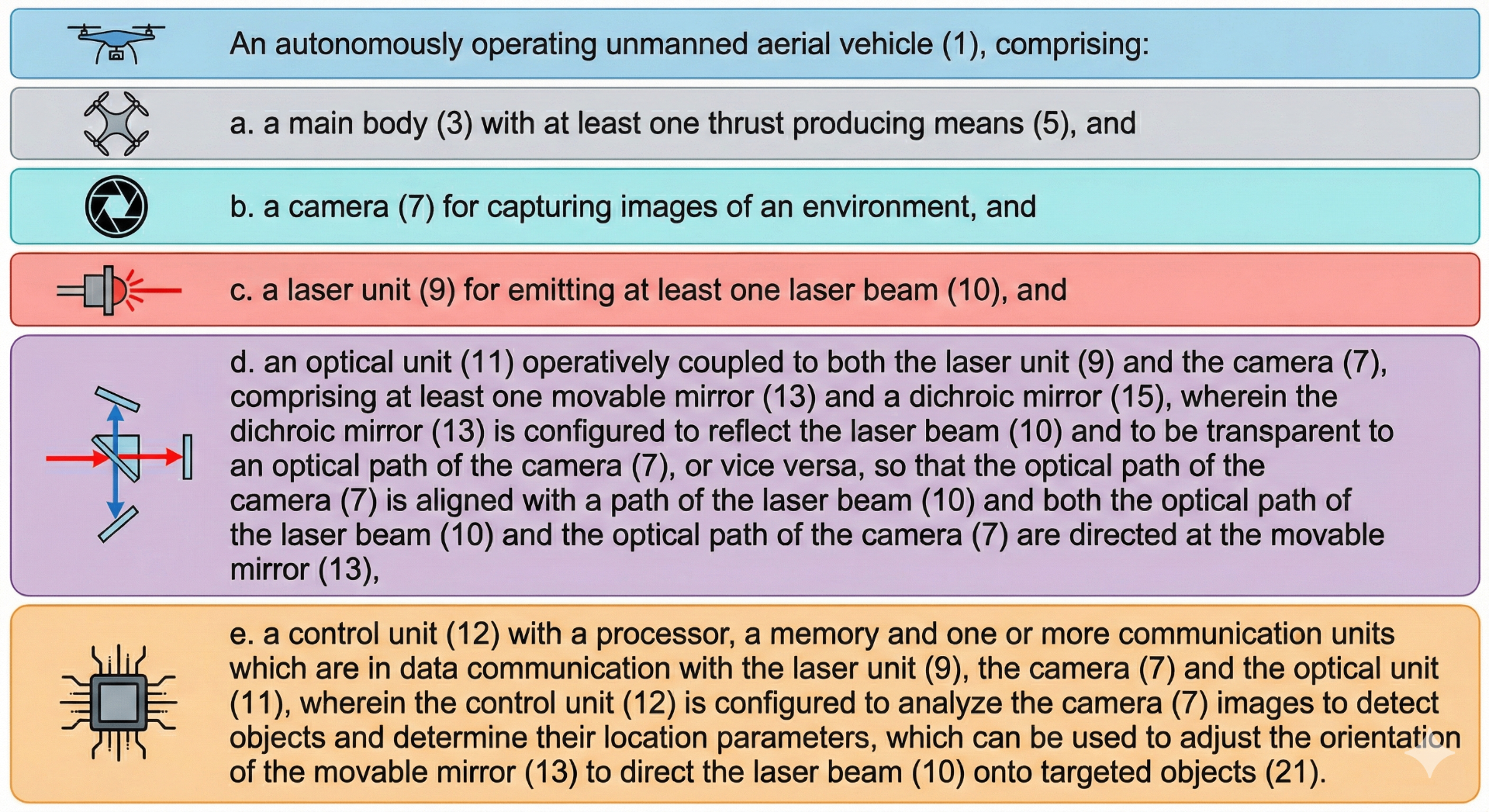
Our UK Green Channel patent secures the core optical architecture, with a granted claim that validates an initial permissible scope.
Global Coverage
Our UK Green Channel patent secures the core optical architecture. We have expanded this protection globally through broader filings in the US and under the PCT.
Divisional Strategy
The specification is engineered with dense itemized lists to fuel a rapid-fire stream of divisional patents — covering every deployment mode, from drones and tractor booms to ground rovers and rail systems.
Vertical Moat
The moat extends to critical enabling technologies — cooling cycles, safety algorithms, hunting methods, and the optical unit independent of mobility mode. We own the fundamental landscape of photonic pest control.
Financial Upside
Up to €650/ha in Combined Value
By replacing chemical inputs with physical alternatives, farmers can unlock substantial financial incentives through EU subsidies and corporate sustainability premiums.
Eco-Scheme Subsidies
Under the EU Common Agricultural Policy (EU CAP, 2023), farmers adopting non-chemical pest control qualify for direct payments rewarding sustainable practices.
Biodiversity Insetting Premiums
Corporate sustainability programmes like McCain's Biodiversity Insetting (2024) offer additional per-hectare premiums for measurably reduced chemical inputs.
Green Deal Alignment
The European Green Deal mandates a 50% reduction in chemical pesticide use by 2030 (European Commission, 2020) — creating regulatory tailwinds for physical alternatives.
Photonic insecticides are not just a technical innovation — they are a financial instrument. Every hectare shifted from chemical to physical pest control generates measurable value through policy incentives, corporate premiums, and avoided environmental costs.
Competitive Landscape
Alternative Methods & Their Limitations
Every alternative method carries a critical weakness that limits its real-world effectiveness.
| Technology | Main Mechanism | Primary Downside |
|---|---|---|
| Sterile Insect Technique (SIT) | Releasing mass-reared sterile males to prevent mating. | Logistical challenges in mass-rearing billions of insects and radiation-induced fitness loss in males. |
| RNA interference (RNAi) | Genetic "dimmer switch" that silences vital pest genes. | Rapid environmental degradation from UV/rain and digestive enzymes that neutralize the RNA. |
| Mechanical (Beetle Beater) | Physical removal via rotating brushes or vacuums. | Causes plant stress, soil compaction, and a logistical bio-waste disposal problem. |
| Nematodes | Predatory worms that infect beetles in the soil. | Extreme sensitivity to UV and temperature; struggle to reach larvae on upper foliage. |
| Bacterial (Bt tenebrionis) | Toxins that destroy the beetle's gut. | Only effective against young larvae and highly UV-sensitive, degrading in under 24 hours. |
| Entomopathogenic Fungi | Natural spores that penetrate the beetle's shell. | Inconsistent field performance — heavy reliance on humidity and specific temperature windows. |
| Predatory Insects | Releasing natural enemies (e.g. ground beetles). | Hand-releasing predators is not feasible at scale; can't outpace the beetle's reproduction. |
| Botanical Extracts | Natural repellents like Neem or Lemon Balm. | Very short residual protection (often <48 h) and can cause leaf damage at high concentrations. |
| LaserFly (Pantec Biosolutions) | Ground-based laser robot using a 2.94 µm wavelength at 100 W peak power with AI targeting. | Ground platform limits coverage speed and adds soil compaction; 2.94 µm is heavily absorbed by atmospheric moisture. |
| Carbon Robotics LaserWeeder | Tractor-pulled laser array using CNNs to destroy weeds. | Designed for weed control, not pests. Requires tractor operation — limiting autonomy and adding soil compaction. |
Each of these methods has advantages and disadvantages that vary by region, climate, crop type, and local pest pressure. However, laser drones depend on remarkably few external factors: no chemicals to degrade, no organisms to rear, no humidity or temperature windows to hit. It is fair to presume that in a substantial set of real-world cases, laser-based pest control will prove superior precisely because it sidesteps the environmental dependencies that limit every alternative.
Investor Finder's Fee
Know an investor who would be interested? We offer a finder's fee for successful introductions that lead to investment. Help us connect with the right capital partners and share in the success.
Introduce an InvestorGet Project Updates
Be notified of milestones, field trials, and technical breakthroughs as they happen.
Crowd Equity Campaign
Get notified if we launch a crowd equity campaign so you can invest early.