
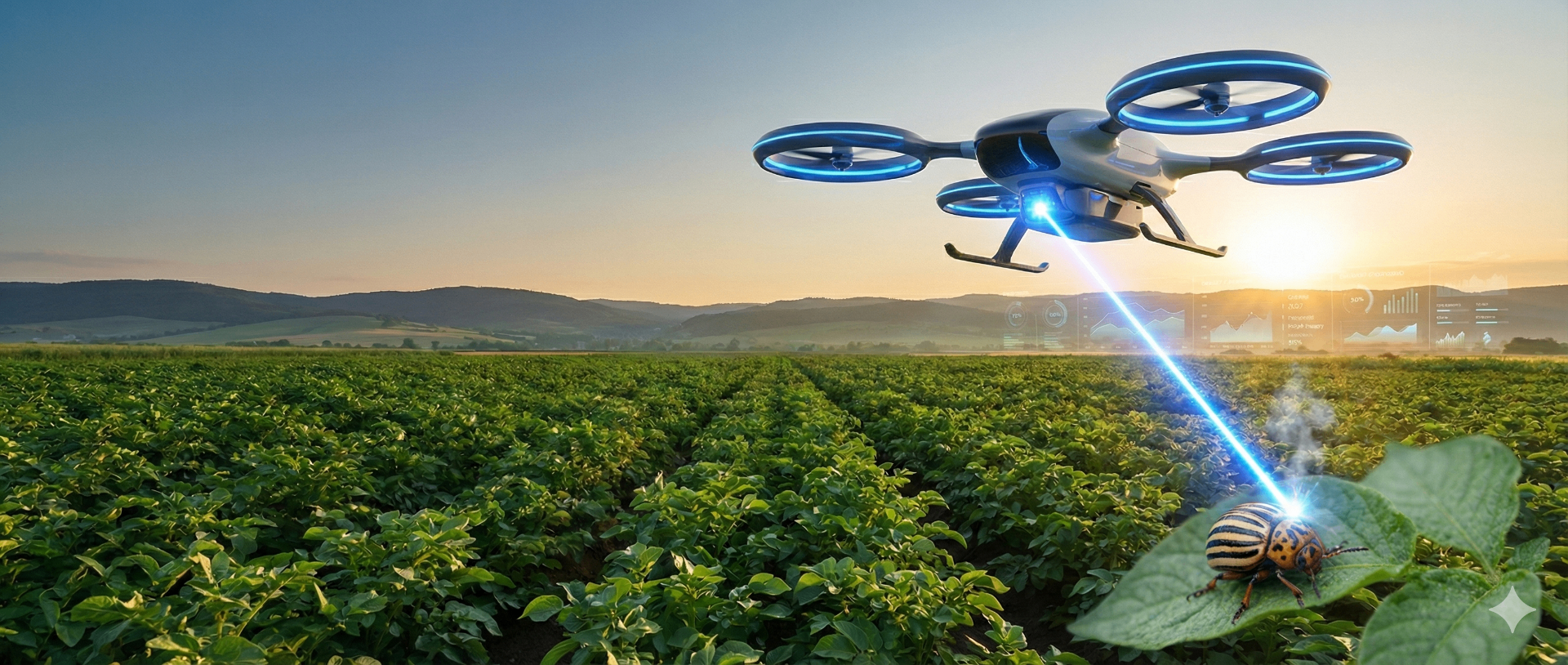
 Concept art
Deep Dive
How Photonic Insecticides Work
A two-phase autonomous system that decouples AI-powered scouting from surgical laser elimination. Peer-reviewed, EU-funded, and built on proven optical architectures.
Architecture
Two-Phase Approach
We revolutionize crop protection by decoupling high-speed detection from surgical elimination.
1. Scouting & Mapping
Our scouting units map the field to pinpoint individual pests with centimeter precision, creating a digital blueprint of the infestation.
2. Precision Elimination
This data guides our laser drones along a pre-calculated path, delivering instant thermal strikes on confirmed targets without wasting energy on searching.
By focusing exclusively on confirmed targets, we maximize battery life and operational speed for a truly scalable solution. Commercial pest-mapping solutions already exist — for example, Agro-Scout builds pest maps for Colorado beetle using AI-powered scouting.
The Optical Engine
How It Works
Our system mimics the biological eye, replacing slow gimbals with a lightning-fast MEMS mirror — surgical precision at 226 Hz.
1. Detect
A static wide-angle camera continuously maps the plant to spot pests instantly.
2. Engage
The MEMS mirror steers the laser and telephoto lens to the target with sub-millimeter accuracy.
3. Neutralize
Capable of 226 switches per second, the system targets clusters faster than they can react.
4. Stabilize
Predictive algorithms cancel drone vibration, keeping the laser locked on target.
The foveated camera is a proven technique capable of fast optical tracking of an object with a telelens camera.
1 Watt of Optical Power = 4 Grams
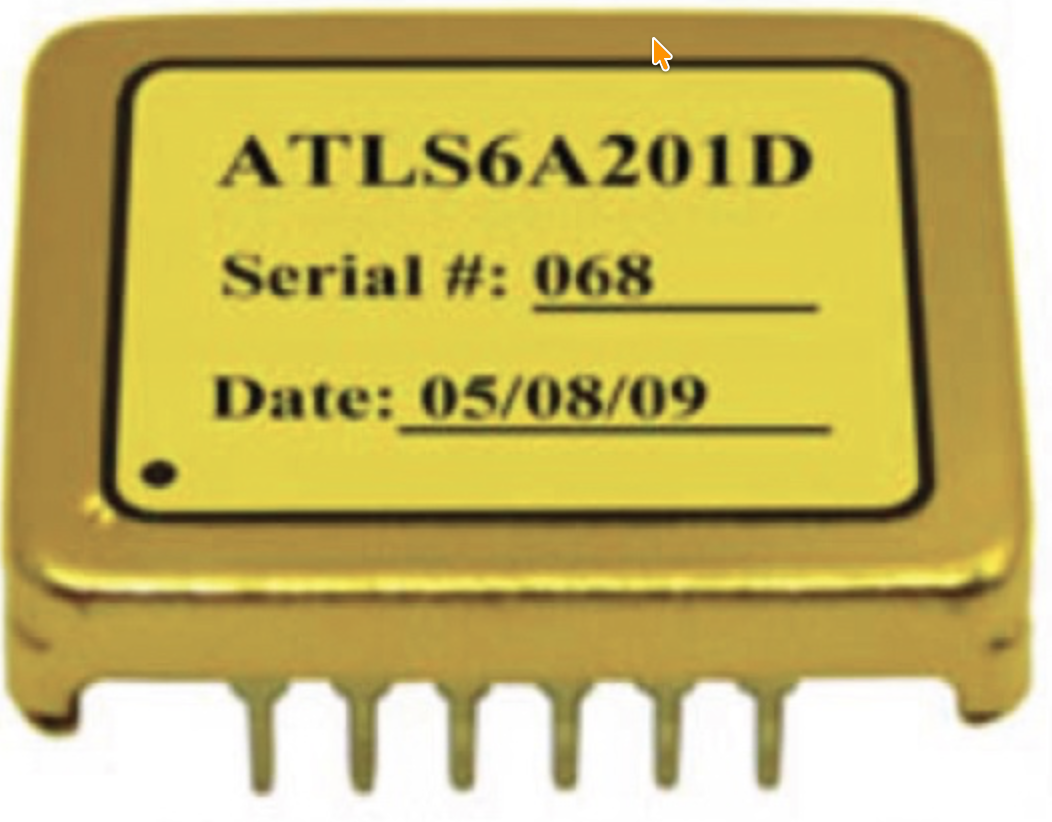
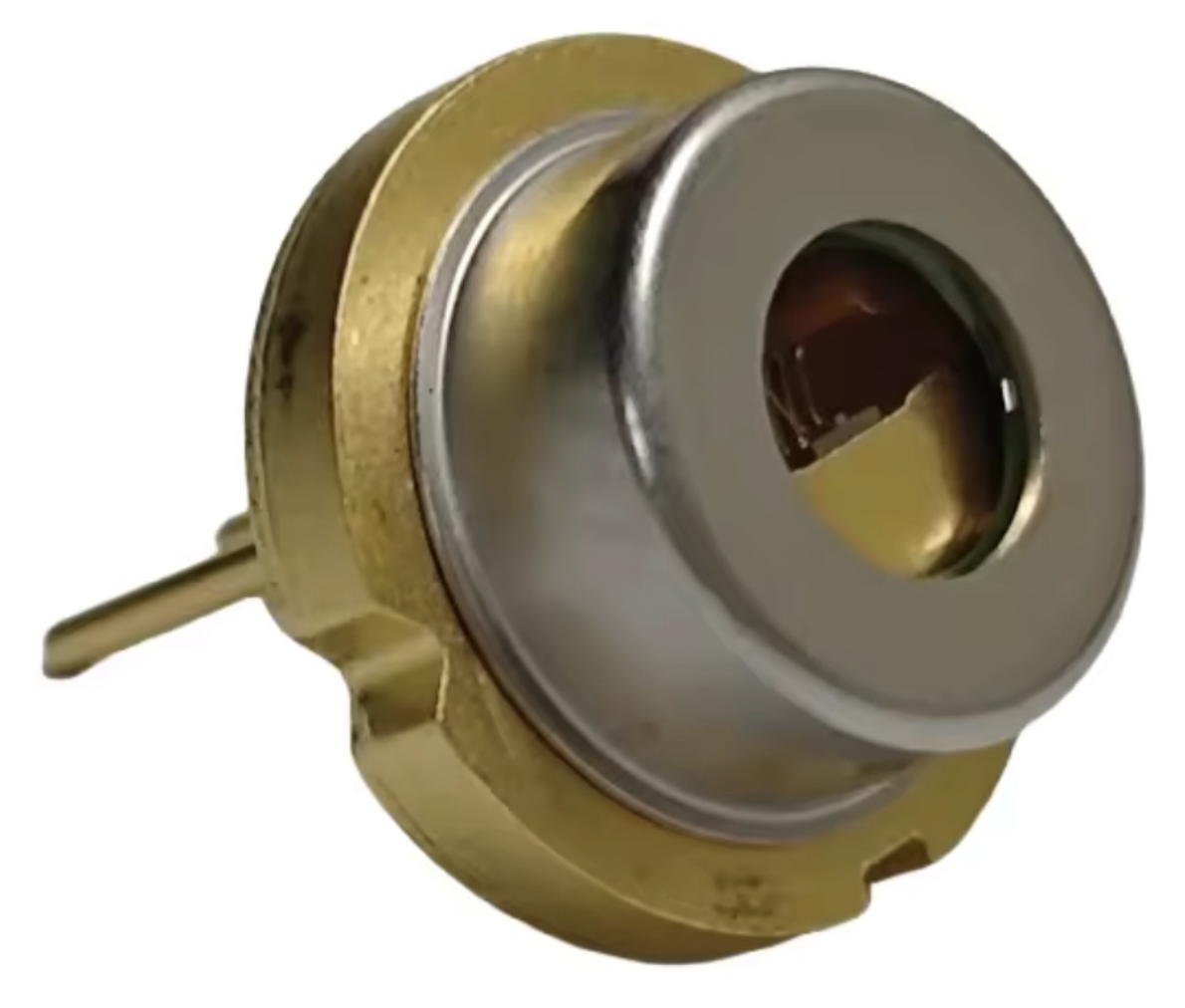
The laser driver weighs just 6 grams and can drive two 1550 nm, 1 W optical power diodes. Each diode weighs only 1 gram, bringing the total to just 8 grams for 2 W of optical power.
Since the laser fires intermittently — targeting individual pests in short bursts — the cooling requirements are minimal. No heavy heat sinks needed, keeping the payload ultralight for drone flight.
6g
Driver
1g
Per Diode
1550nm
Wavelength
Aiming Feasibility
Commercial DJI drones already offer 7× the aiming precision required for effective laser targeting — proving that the necessary mechanical stability is available off the shelf.
Commercial Benchmark: DJI Zenmuse H20
Performance Specifications (2025)
- Angular Jitter: ±0.01°
- Lateral Equivalent: at 1 m stand-off, ≈ 0.17 mm of lateral motion
Target Applications
- • Colorado beetle control in potato fields
- • Stink bug management in orchards
- • Scalable to various crop pests
Research & Development
Stopping the Exponential Curve
The Mathematics of Suppression
Don't Fight the Army. Stop the Scouts.
The Old Way — Reactive Spraying
Farmers wait until pest damage is visible before spraying. By then, exponential reproduction has already occurred — a single female Colorado beetle lays up to 800 eggs. The field is overwhelmed, requiring massive chemical doses at a cost of $54 per hectare.
Treating millions of larvae after the population explodes
The New Way — Perimeter Patrol Strategy
Our autonomous drone patrols the field perimeter, intercepting the estimated 200 adult beetles per hectare/day migrating in — before they lay eggs. Patrolling every ~48 hours, we neutralize colonizing adults at the edge before reproduction begins.
Intercepting hundreds of scouts before they multiply
The "Aha!" Moment
By constantly removing the few "parent" beetles at the field's edge, we suppress the exponential growth curve entirely. We don't need to kill millions of larvae — we just need to stop the hundreds of adults from multiplying. No parents, no eggs, no army.
The Feasibility Claim
Because we are hunting a low-density population at the perimeter — not carpet-bombing the entire field — the energy cost is minimal. This makes a price point of $10 USD per hectare/season scientifically feasible, a 5× cost reduction compared to chemical treatments.
The Stop-and-Hop Maneuver
The Perimeter Hop Model
We don't randomly patrol a whole field. We run a perimeter defense, catching Colorado Potato Beetles as they invade from the edges — using a precise "stop-and-hop" maneuver.
1. The Hover
Action Time — 1.0 second
The drone holds perfectly still for exactly one second. This precision window lets it lock onto the beetle and neutralize it with the photonic beam.
2. The Launch
Acceleration — 5 m/s²
The drone kicks into high gear, accelerating hard toward the next target before the beetle moves deeper into the field.
3. The Brake
Deceleration to v = 0
The drone reverses thrust and comes to a complete stop directly over the next target, converting speed back into stability to restart the cycle.
How the Model Calculates the Upper Bound
A conservative, worst-case estimate — if the system works under these strict assumptions, real-world operation will only be more efficient.
Upper Bound of Flight Time
- • The model assumes the drone must completely stop, act, and restart for every single beetle — no smooth fly-overs.
- • Total time = acceleration/deceleration time + hover time per beetle.
- • This establishes a worst-case daily requirement. Any real-world optimization only makes it more efficient.
T = 2√(N·D / a) + N · t_actTotal clearing time per slice
Energy & Battery Cost
- • Stop-and-hop movement is energy-intensive — frequent acceleration demands high power (~90 W).
- • Electricity is cheap; batteries are not. The real cost is battery depreciation over its cycle life (L ≈ 1,000 cycles).
- • Unit energy cost = battery price ÷ lifetime energy, multiplied by power × time for each hop.
C_energy = (C_batt / (L · E_cap)) · P · TCost per slice
Fleet Size Calculation
- • Required flight hours vs. available daylight hours dictates fleet size.
- • At high pest pressure (1,600 beetles/ha) the model calculates ~26.3 flight hours/day.
- • A 3-day visitation cycle or optimized routing collapses this requirement, letting fewer drones cover more ground.
N_drones = ⌈T_required / T_daylight⌉Minimum fleet size
The Hop Model proves the system is viable even under worst-case assumptions. As flight-path optimizations are applied — continuous flight, traveling-salesman routing — fleet requirements collapse, making a single drone capable of covering what the model initially requires several to handle.
Thermodynamic Feasibility
The 0.5–3.5 Joule Feasibility Range
The lower bound models a ~1 mm³ neural target; the upper bound heats a conservative 8 mg head mass and includes thermal loss. Optical absorption is based on VUB spectrography, while lethality curves are still being measured.
1mm³
Thermal Target
The pest's neural center is modeled as a cubic millimeter of water — allowing precise energy calculations for denaturation.
0.5–3.5 J
Per Beetle
Feasibility range from a ~1 mm³ neural target to a conservative whole-head thermal model, including optical coupling and heat loss.
Speed
Not Energy
Laser pest control is not an energy problem — it's a speed challenge. The bottleneck is target acquisition, not power.
~60k–400k
Shots Per Battery
For a 200 kJ usable energy budget, the thermal estimate remains small relative to propulsion energy even across the full kill-energy range.
The per-insect energy budget is grounded in the peer-reviewed literature: a 2025 Precision Agriculture study quantifying the laser energy required to neutralize an insect ↗.
Broad Applicability
Universal Physics for Every Environment
Pests don't discriminate, and neither does our technology. From open potato fields to high-tech greenhouses, the core principle remains: AI-driven precision over chemical saturation.
If you can see it, we can shoot it.
Open-Field Row Crops
Drones patrol broadacre potato, corn, and wheat fields targeting Colorado beetles and corn borers.
Orchards & Vineyards
Trunk and canopy patrol intercepts spotted lanternflies and Japanese beetles in perennial systems.
Greenhouses & Vertical Farms
Rail-mounted systems navigate rows to eliminate whiteflies and spider mites in contained environments.
Specialty & Arid Lands
Intercept migratory desert locusts and protect high-value crops like cotton from bollworms.
Feasibility
Validated Science. Operational Reality.
Our feasibility study confirms that the Colorado Potato Beetle is the perfect target for photonic control.
The Perfect Target
Beetles naturally bask on the top of leaves, making them high-contrast targets for our AI and "sitting ducks" for the laser.
The Safety Advantage
We utilize 1550 nm lasers — a wavelength that is safer for human eyes and creates zero flammability risk for the crop.
The Numbers Work
With an arrival rate of ~200 beetles per hectare/day and a 3-day window before they lay eggs, a single drone can easily outpace the infestation using negligible battery power.
The Missing Link
Late Blight & True Potato Seed
Photonic insecticides are the critical enabling component for True Potato Seed systems — connecting beetle control to the billion-euro late blight problem.
TPS Vulnerability
True Potato Seed offers a genetic solution to Phytophthora infestans (Haynes et al., 2022), but its fragile seedlings are highly vulnerable to the Colorado Potato Beetle (Martin, 1988).
Photonic Protection
Autonomous laser drones provide non-chemical, precision defence for these delicate seedlings — eliminating the beetle threat without harming the crop.
Unlocking Blight Resistance Value
By safeguarding TPS seedlings, the technology unlocks the massive economic value of blight resistance — estimated at €1,000–€1,500/ha in NW Europe (Europatat Action Plan, 2024; NEPG, 2024).
Late blight costs European potato farmers billions annually. TPS varieties resist the disease genetically — but only if their seedlings survive the beetle. Photonic insecticides close this gap, turning a laboratory breakthrough into a field-ready reality.
Safety & Compliance
Eye Safety & Regulation
A "defense in depth" strategy combining passive physics, active AI monitoring, and regulatory compliance to eliminate the risk of accidental injury.
Rapid Beam Divergence: Why It's Safe
Passive Safety (Physics & Optics)
Rapid Beam Divergence
A high-numerical-aperture optical design causes the laser beam to diverge rapidly past the focal point, rendering the energy density harmless to bystanders just meters away.
1550 nm Wavelength
The 1550 nm wavelength is absorbed by the eye's corneal moisture rather than reaching the retina, preventing permanent, irreversible neurological blindness.
Convex Insect Geometry
The natural convex geometry of insect targets acts as a dispersive surface, ensuring reflected energy is scattered diffusely rather than bouncing off as a dangerous, concentrated beam.
Active Safety (Software & AI)
An active AI vision system monitors the environment in 360 degrees, instantly inhibiting the trigger if a human is detected within the safety perimeter. Combined with the passive safeguards, these mechanisms create a "virtual enclosure" that effectively eliminates the risk of accidental injury while satisfying rigorous regulatory safety standards.
Regulatory Pathway
The regulatory pathway for an open-air Class 4 device relies on the principle of "Active Guarding" or "Virtual Protective Housing," recognized under international safety standards like IEC 60825-1 and the US ANSI Z136.
While the default rule requires a physical enclosure, these regulations permit "Engineering Controls" to substitute for physical walls if they provide an equivalent level of protection. The safety system must be certified to a rigorous reliability standard, such as Performance Level 'd' or 'e' under ISO 13849-1.
In the United States, this allows applying for a Variance from the FDA (CDRH) under 21 CFR 1040.10, granting legal permission to operate a high-power laser in the open — because the "virtual" walls are proven to be just as safe as real ones.
The Journey
Development Progress
From research to reality. Track our journey to revolutionize agriculture.
EU Funding Acquired
After evaluation by 12 leading experts from PhotonHub — the photonics innovation hub funded by the European Union — the project was granted EU funding and commenced in March 2025. A technical expert from VUB Brussels Photonics prepared the proposal with a Central Business Coach. Further findings are available on the uploaded slides on Cordis.
Safety Milestone Achieved
A main technical hurdle was overcome after the VUB Brussels Photonics department concluded that the laser technology can be made eye-safe for humans.
Technical Verification
All secondary parameters, including energy consumption, weight, and cost, were verified and found compliant. The system meets all defined operational specifications.
Patent Granted
First patent granted in the UK. Additional patents pending in other jurisdictions to protect the technology.
Demonstration Videos
Every demonstration video — laser lethality, prototype flight tests, real-field larva tracking, event-camera detection and the reference optical architecture — is collected in a single gallery on the home page, so you don't have to hunt for one.
Watch all videosSince safety and energy constraints are critical factors that could limit technological adoption, both a human eye safety calculator and an energy consumption simulator have been developed. Results show that the drone's power demand is minimal, with battery depreciation representing the main operational cost. Emerging battery chemistries, such as sodium-ion, are rapidly reducing this cost.
Dig Deeper
Resources & Research
Explore our research, demonstrations, and the scientific community calling for pesticide alternatives.
Scientific Documentation
Video Demonstrations
Related Projects
Global Advocacy
Scientists and NGOs worldwide are ringing the alarm bell about pesticide effects.