
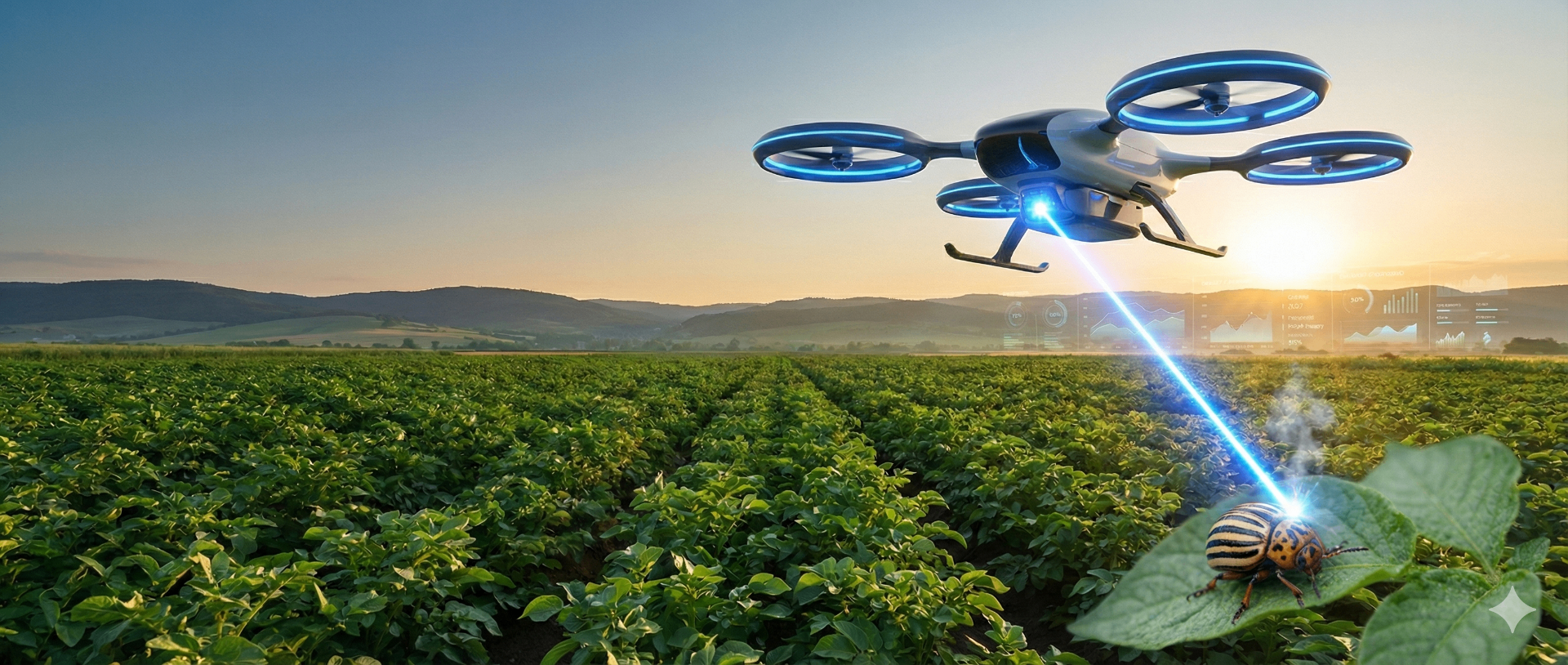
 Concept art
For Farmers & Growers
Reliable Autonomous Pest Control
No chemicals. No resistance. No drift. Autonomous laser drones patrol your fields and eliminate pests with surgical precision — safely and sustainably.
The Missing Link
Late Blight & True Potato Seed
Photonic insecticides are the critical enabling component for True Potato Seed systems — connecting beetle control to the billion-euro late blight problem.
TPS Vulnerability
True Potato Seed offers a genetic solution to Phytophthora infestans (Haynes et al., 2022), but its fragile seedlings are highly vulnerable to the Colorado Potato Beetle (Martin, 1988).
Photonic Protection
Autonomous laser drones provide non-chemical, precision defence for these delicate seedlings — eliminating the beetle threat without harming the crop.
Unlocking Blight Resistance Value
By safeguarding TPS seedlings, the technology unlocks the massive economic value of blight resistance — estimated at €1,000–€1,500/ha in NW Europe (Europatat Action Plan, 2024; NEPG, 2024).
Late blight costs European potato farmers billions annually. TPS varieties resist the disease genetically — but only if their seedlings survive the beetle. Photonic insecticides close this gap, turning a laboratory breakthrough into a field-ready reality.
Economics
Cost Comparison
See how photonic pest control compares to chemical spraying in real-world costs.
$54/ha
Chemical Spraying
Current average — rising to $200/ha as neonicotinoids are phased out
~$10/ha
Photonic Control
Battery depreciation is the main cost — energy per pest is negligible
+€650/ha
EU Subsidies
Additional value through Eco-scheme subsidies and biodiversity premiums
Safety First
Multi-Layer Safety
A "defense in depth" strategy combining passive physics, active AI monitoring, and regulatory compliance to eliminate the risk of accidental injury.
Rapid Beam Divergence: Why It's Safe
Rapid Beam Divergence
A high-numerical-aperture optical design causes the laser beam to diverge rapidly past the focal point, rendering the energy density harmless to bystanders just meters away.
1550 nm Wavelength
The 1550 nm wavelength is absorbed by the eye's corneal moisture rather than reaching the retina, preventing permanent, irreversible neurological blindness.
Convex Insect Geometry
The natural convex geometry of insect targets scatters reflected energy diffusely rather than bouncing it off as a dangerous, concentrated beam.
Active AI Safety
An active AI vision system monitors the environment in 360 degrees, instantly inhibiting the trigger if a human is detected within the safety perimeter — creating a "virtual enclosure" that eliminates the risk of accidental injury.
Full Safety & Regulatory DetailsThe Logical Next Step
Spray Drone vs. Laser Drone
The industry is moving towards drones. Laser-based drones are the logical next step — trading toxic fog for the speed of light.
Chemical Spray Drone
Dynamic mass, decreases during flight
Return-to-base for liquid & battery
Wind-dependent, requires buffer zones
Corrosive chemicals, clogs & leaks
Pests build chemical resistance
Photonic Laser Drone
Static mass, constant during flight
Return-to-base for battery only
Light travels straight — precise
Solid-state optics, sealed unit
No known physical resistance mechanism
We replace corrosive plumbing and toxic drift with solid-state optics that never clog, leak, or miss. This eliminates the "pit crew," hazmat suits, and buffer zones — allowing you to farm every inch of land. Zero chemicals, zero resistance, zero waste.
Feasibility
Validated Science. Operational Reality.
Our feasibility study confirms that the Colorado Potato Beetle is the perfect target for photonic control.
The Perfect Target
Beetles naturally bask on the top of leaves, making them high-contrast targets for our AI and "sitting ducks" for the laser.
The Safety Advantage
We utilize 1550 nm lasers — a wavelength that is safer for human eyes and creates zero flammability risk for the crop.
The Numbers Work
With an arrival rate of ~200 beetles per hectare/day and a 3-day window before they lay eggs, a single drone can easily outpace the infestation using negligible battery power.
Help Us Build It
Support This Research
We need letters of intent from farmers to secure funding. It doesn't commit you to anything — it simply signals real-world demand to investors and grant bodies.